Showing posts with label nectar. Show all posts

Sunday, October 1, 2023

Don't BEE Scared

October is a month filled with festivities and a touch of fear, but honey bees outside their hive are nothing to be afraid of. While you're outdoors, enjoying the sight of flowers or sipping on sweet beverages, you might notice honey bees buzzing around. Don't panic! These foraging honey bees have one mission in mind—they're simply searching for food, not interested in bothering you.
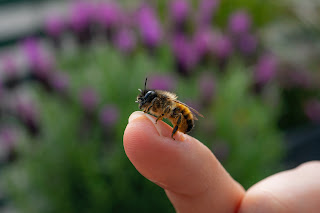
 
Curious honey bee on a finger.

Nectar is a part of a healthy honey bee diet, and they drink and collect it from flowers. Honey bee's sense of smell is remarkable, around 50 times stronger than a dog’s. This ability enables them to detect the aroma of the sugary liquids from flowers or even your soda, drawing them from distances of up to 5 miles away.
Honey bee drinking honey from a hand.


Although they have a great sense of smell, the honey bees' vision has its limitations. They can perceive colors such as purples and blues from afar but need to be close to observe finer details. So, if a honey bee ever comes near you or lands on you, it's not an act of aggression—she simply mistook you for a flower. During such encounters, it's best to remain still and allow the honey bee to explore its surroundings. These gentle creatures pose no harm unless threatened. Attempting to swat them away may provoke them to defend themselves with a sting.

Curious honey bee in a hand.

Monday, May 1, 2023

Top Flowers & Plants Honey Bees Like

Honey bees collect nectar and pollen from the flowers and plants they visit. However, there are certain flowers and plants that they tend to visit more than others. Knowing which flowers and plants that better attract honey bees can allow you to plant the right ones in your garden. Each type of flower has a different blooming season, length of life, and how tall they are. Knowing these details allows to you pick the perfect ones based on your needs.

Some of the top flowers that honey bees like are:

Bee Balm

  • Blooms in the Spring, grows back every year, and grows to 1-4 feet tall.

Black-Eyed Susan
  •  Bloom in the Summer and Fall starting the 2nd year, grows back every year, and grow to be 1-3 feet tall.
Purple Coneflower
  •  Bloom in the Summer and Fall, grows back every year, and grows to 2-4 feet tall.
Sunflower
  •  Bloom in the Summer and Fall, only grow/live for one season, and can range in height from 1-15 feet tall.
Wrinkle-Leaf Goldenrod
  •  Blooms from late Summer to Fall, grows back every year, and is about 3-4 feet tall.


Wednesday, March 1, 2023

Benefits of Honey

Honey is a great food that both honey bees and humans consume. Honey bees collect pollen and nectar from flowers that they visit during pollination which they take back to their hive to turn into honey. Honey is primarily made up of sugars and water, with trace amounts of vitamins and minerals. Some of the key vitamins and minerals are: calcium, copper, iron, magnesium, manganese, phosphorus, potassium, zinc and more!

One way to use honey in addition to consuming it, is using it for wound care. Honey has been shown to speed up the process of wound healing, particularly burn wounds. 

Honey can also be used as a cough suppressant. This is because honey helps thin mucus and loosen coughs. Just taking two teaspoons of honey can help relive nighttime coughs for better sleep and more comfortability. 

Honey also can help various diseases by reducing heart risks, lowering memory loss, and even boosting one's mental health. In addition, honey contains antioxidants, which helps protect the body from inflammation. 


Tuesday, December 1, 2020

What do Bees Eat?

Did you know that honeybees eat more than just honey? They eat a couple different types of food to stay healthy and have energy to work!

Of course honeybees eat honey! They make it from nectar, the sugary substance flowers make to invite the bees to visit. The honeybees gather this nectar to make into honey. You can learn about how honeybees make honey in our past post called “How Do Honeybees Make Honey?” The honey they eat is the source of carbohydrates and gives them energy. Did you know that honey is a good energy source for humans too!
The pollen baskets are packed full!

Honeybees also eat pollen (a powdery substance flowers make) for their protein. They mix the pollen with nectar and pack it onto their back legs into their pollen baskets. They then carry the pollen home to feed to the brood (baby bees). This pollen keeps the honeybees healthy so they can fight off infection in the hive and help the baby bees grow big and strong.
The milky substance inside the cells is royal jelly.


Royal jelly is a milky, protein rich substance that the honeybees feed special eggs to make them become a queen bee. If the egg wasn’t fed royal jelly then it would become a worker bee, but when an egg is fed the special food it supercharges their development so that they are able to lay eggs and become a queen bee. Royal jelly is made from glands in the bees’ head. Some people like to eat royal jelly because it has so many healthy proteins in it. While it doesn’t turn you into a queen bee it can be a great way to keep yourself healthy.

Lastly, honeybees drink water. All living animals need water and honeybees are no different. They look for slow moving sources of water because honeybees can drown. Pollinating and collecting nectar is a hard job and the worker bees need somewhere safe to land to take a drink of water. We wrote back in February about how you can build your own bee water bath!

Friday, June 1, 2018

Honey Varieties

The Clover Honey pictured is made from the nectar of
the purple clover flowers also pictured.

Honey is a sweet treat that our honey bee friends make! The honey they make, and we enjoy, is made from the nectar of flowers. Each flower has a unique nectar that produces a unique honey. There are more than 300 different honeys in the United States, and more than 3,000 in the world. 


Those hundred and thousands of honey varieties have different tastes, textures, colors, and characteristics. Some honeys crystallize quicker than others, while others have an overall thicker consistency. You can have honey that is almost clear in color like Fireweed, but also honey that is so dark you can’t see through it like Buckwheat. With those different colored honeys comes different flavors and uses.

Honey’s beautiful spectrum of colors provide endless opportunity. Darker colored honeys have a stronger taste and can be great for cooking with meat. The lighter colored honey varieties are sweeter and perfect for using in baked goods.


A small sample of the varieties of honey
made by honey bees.
Some honeys even have very unique flavors based on the flowers the nectar came from. Orange Blossom Honey is a lighter colored honey, almost orange in color! It is sweeter and you can taste the citrus in it. Another unique honey is Sage Honey. It is a lighter colored honey that granulates (gets hard) slower than other types of honey.

The next time you are at a farmer’s market or see a honey booth at a fair or festival, look at the different honey for sale. You might see a wide variety of colors, and if you get the chance, you’ll be able to taste the different flavors and textures.

Monday, May 1, 2017

Can Honeybees Talk?

Animals communicate in many different ways. Some communicate through touch, while others use sounds or smells. With between 20,000-80,000 honeybees per hive, have you ever wondered how honeybees communicate? A hive of honeybees works together so seamlessly and instinctively--their communication process is fascinating! Honeybees communicate using three different methods: dance, vibrations, and pheromones. 


The honeybee uses several different types of dance. One of the dances is called the waggle dance. You can see an example of the waggle dance below. After the honeybee comes into the hive with a full load of nectar and pollen, she uses this dance to tell her sisters what she has found and where it is located. The worker bee will face a certain direction and wiggle at a certain speed during the dance. This will share with the other honeybees the direction of the nectar source, how far it is, and how many honeybees need to go there to collect the nectar. The other bees then follow her directions and find the flowers to forage for the hive. Another dance they use is called the round dance, which tells the bees that the flower source is close to the hive. 


The honeybee also communicates through vibrations and pheromones. Honeybees vibrate their bodies and let off certain smells which tell the other bees in the hive what needs to be done. The queen will send a scent to the queen’s court if she needs to be fed or groomed. She is constantly communicating with the worker bees through vibrations and smell. The worker bees will also communicate to other worker bees if the baby bees need to be feed or if the hive needs to be cooled. By vibrating and letting off pheromone smells, the other bees know exactly what is needed throughout the dark and crowded hive. 


Even though honeybees cannot talk like you and me, they are still able to communicate beautifully. It’s remarkable to see them use dance, vibrations, and pheromones to live in harmony and work together. What an amazing insect!

Saturday, August 1, 2015

Honey, the Liquid Gold

The many colors of honey!
Have you ever wondered why there are different colors and flavors of honey? Each kind of flower produces a different flavor and color nectar that bees use to make honey. We have different kinds of honey because honeybees are flower consistent. This means that instead of going from one kind of flower to another, (like from a sunflower to an orange blossom, and then to a clover flower) she will work one kind of flower on each trip until there is no more nectar in those flowers. When beekeepers bring their bees to pollinate a specific crop, like blueberries, the bees will only be visiting blueberry flowers, so it will make blueberry honey. There are actually more than 300 different kinds of honey in America, and more than 3,000 kinds in the world! Each type of honey has a unique flavor and color. The color of honey can range from a clear “water-white” to a dark brown color. The lighter honeys have a mild flavor, while darker honeys have a strong, bold flavor. It’s fun to try different kinds of honey and taste and see the difference between each of them.


Besides its deliciously sweet taste, honey also has many health benefits that make it good for you. Honey is a good source of carbohydrates. Carbohydrates are your body’s primary fuel for energy. This makes it a great energy booster! If you play sports, try some honey before your next game or practice to give you an extra energy boost. Many athletes and Olympians use honey for energy. Honey is also full of antioxidants which help protect cells in your body from harmful molecules. There are also lots of vitamins and minerals in honey. Vitamins and minerals boost your immune system, help you grow and develop properly, and help cells and organs do their jobs. Lastly, honey is antibacterial, so it kills bacteria and keeps you healthy. 


Honey is also wonderful to use in cooking, and is useful as more than just a sweetener. It can add a special touch to any recipe. With all the unique flavors to choose from, it can add great flavor to your recipes. Honey is a humectant, which is something that holds moisture and water, so it helps keeps baked goods moist and soft. Honey is antibacterial and antifungal so it keeps bacteria and mold from growing and helps baked good last longer. Honey is also an emulsifier and thickener. If you were to take water and oil and mix them together and shake it vigorously, little oil droplets are dispersed throughout the water. Then, if you let it sit, the water and oil will separate. What an emulsifier does is bind things together, so it would help that water and oil to mix together and not separate. Because honey is an emulsifier and thickener, it works well in sauces and dressings. 

Try this delicious and easy honey recipe to cool off and get energized this summer!

Fruity yogurt honey pops 
Honey is a sweet addition to any recipe.

  • 1 cup - pitted cherries or ½ cup strawberries (or other fruit of your choice)
  • 1 cup - nonfat Greek yogurt
  • 2 tablespoons - honey
In a small food processor or blender, puree the fruit for 30 seconds to 1 minute. Do not blend for too long or the puree will become too watery. In a measuring cup or bowl with pouring spout, stir together the yogurt and honey. Stir in about 2 tablespoons of the fruit puree. Taste and add more honey or fruit puree as desired. Pour fruit and yogurt mixture into popsicle molds, filling about ¾ of the way. Add wooden sticks and freeze for at least 3 hours. To remove: run warm water over the bottle of the popsicle mold and gently twist and pull out the popsicles.

Monday, July 1, 2013

Liquid Gold


A worker bee gathering nectar
For beekeepers, summertime is a very important season – it is time to extract honey from the beehive! Throughout the spring and early summer, honey bees work hard gathering nectar from flowers. They store the nectar in a very special sac called a honey sac. The bee flies back to the hive and gives it to another work bee. The bees pass the nectar from bee to bee, adding special enzymes to it. Finally, the bees put the nectar in their honey comb. Nectar is like very sweet water, but honey is very thick and sticky. To change the consistency of the nectar, the bees fan their wings and blow air over it to pull some of the water out. When it has the right amount of water, the bees cover it with beeswax to seal and protect the honey.
A full frame of honey!
Now it is the beekeeper’s turn to work. Beekeepers go out to their beehives and carefully remove all of the frames with honey on them. They brush the bees back into the hive and take the frames home. When they arrive, they use a very hot knife to cut the beeswax seal off and expose the honey. It is exciting to see the fresh honey glistening on the honey comb! The beekeeper then puts the frames in a large machine called an extractor. The extractor spins around very quickly; in fact, it spins so quickly the honey flings out of the cells of honey comb and drips down the sides of the extractor to the bottom. At the bottom of the extractor is a spigot. When the beekeeper opens the spigot, golden honey comes streaming out! It is so much fun to see (and taste!) the reward of the bees and beekeeper’s work. The beekeeper can then strain and bottle their honey – it is ready to eat!
Honey is very valuable
Bees make honey by themselves; beekeepers just extract the honey. A beekeeper does not have to add anything to the honey. The bees make it perfectly on their own. Honey is very valuable – in her whole lifetime, a worker bee will produce only 1/12 tsp. of honey. That is about one drop! Honey is a very important and delicious food. So next time you enjoy a spoonful of honey, think about all of the work that went into producing it and thank the bees and beekeepers!