Showing posts with label honeycomb. Show all posts

Monday, May 1, 2017

Can Honeybees Talk?

Animals communicate in many different ways. Some communicate through touch, while others use sounds or smells. With between 20,000-80,000 honeybees per hive, have you ever wondered how honeybees communicate? A hive of honeybees works together so seamlessly and instinctively--their communication process is fascinating! Honeybees communicate using three different methods: dance, vibrations, and pheromones. 


The honeybee uses several different types of dance. One of the dances is called the waggle dance. You can see an example of the waggle dance below. After the honeybee comes into the hive with a full load of nectar and pollen, she uses this dance to tell her sisters what she has found and where it is located. The worker bee will face a certain direction and wiggle at a certain speed during the dance. This will share with the other honeybees the direction of the nectar source, how far it is, and how many honeybees need to go there to collect the nectar. The other bees then follow her directions and find the flowers to forage for the hive. Another dance they use is called the round dance, which tells the bees that the flower source is close to the hive. 


The honeybee also communicates through vibrations and pheromones. Honeybees vibrate their bodies and let off certain smells which tell the other bees in the hive what needs to be done. The queen will send a scent to the queen’s court if she needs to be fed or groomed. She is constantly communicating with the worker bees through vibrations and smell. The worker bees will also communicate to other worker bees if the baby bees need to be feed or if the hive needs to be cooled. By vibrating and letting off pheromone smells, the other bees know exactly what is needed throughout the dark and crowded hive. 


Even though honeybees cannot talk like you and me, they are still able to communicate beautifully. It’s remarkable to see them use dance, vibrations, and pheromones to live in harmony and work together. What an amazing insect!

Friday, July 1, 2016

Preparing for Honey Harvest


The bees have been working hard all summer to gather nectar and convert it into honey. The nectar has been deposited into cells in the honeycomb and the bees have fanned it with their wings to evaporate out much of the moisture. The cell is then capped with wax for storage. At this point, it is considered honey. The honey is their food, or where they get their carbohydrates for energy. This is what we will harvest at the end of summer.

Extractor
In order to prepare for honey harvest, there are a few key pieces of equipment we need to acquire. Keep in mind that beekeepers can have one hive or one thousand hives, which means there are different setups for harvesting honey. The equipment listed here is for a beekeeper that has a small number of hives.

First, we need an extractor. For a small scale beekeeper, this will be the biggest investment for
honey harvest equipment. An extractor is essentially a stainless steel barrel. Inside are baskets that hold frames full of honey. There is a hand crank or motor mounted on top that will spin the baskets inside the steel barrel. At the bottom of the barrel is a gate that controls the flow of honey out of the barrel.


Hot knife
Next is the hot knife. This is a large steel blade that must be plugged in to heat up. It has a wooden handle to protect the user’s hand from being burned. We will also need honey buckets. The quantity depends on how much honey you will be harvesting and bottling. The buckets are a standard five-gallon food grade pail with a gate at the bottom. This bucket will catch the honey from the extractor. For the top of the bucket, some type of strainer is needed. 

Depending on the facility where you are harvesting honey, you may want to cover the floor with a layer of plastic. Honey is incredibly sticky and tends to get everywhere! The plastic will help make cleanup a breeze. Don’t forget about bottles. Small plastic bears to large glass jars are all acceptable, provided they are clean and do not have residues from other foods. Remember to set aside a whole day or more for harvesting, it’s not something you can rush. Once you have all the necessary equipment, you’re ready for harvest!
Honey bucket
Plastic bottle
 
Strainer


Sunday, May 1, 2016

Construction Zone: Building Up a Hive

Very new wax
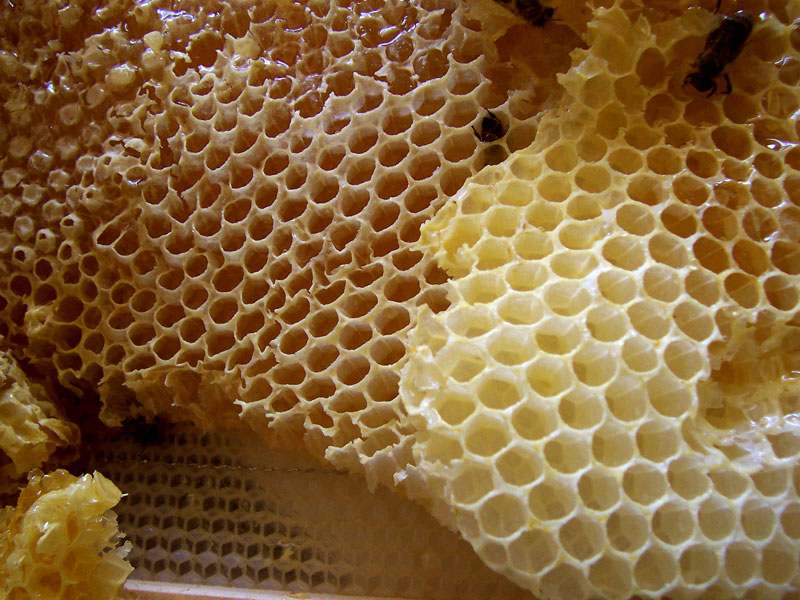
Spring is the time of year when both beekeepers and honeybees are very busy! Once beekeepers install their package of bees in the hives, they generally give them a few weeks to get on their feet. The honeybees' first task is to start building comb. The honeycomb is made of wax that the bees secrete from glands on their abdomen. Each bee can only create a small flake of wax at a time; thus the entire colony must work together to build their comb. When wax is brand new, it is pure white, and then it darkens with age. First year wax will typically be yellow in color. The bees build the comb on top of the hexagon pattern that is molded into the foundation. This process is called "drawing out" the comb. 

New wax being built on black foundation
A closer look, showing orange pollen in cells
The queen will begin to lay her eggs in the drawn comb, one egg per cell. These eggs hatch out into larvae, which look like pearly white crescent shapes inside the cell. The larvae are fed by the worker bees. For beekeepers, seeing eggs and larvae in the hive is a good sign, because this means their queen is working hard and is still alive. After the larvae almost completely fill their cell, worker bees will seal off their cell with wax. This allows the larvae to pupate, or develop its head, thorax, abdomen, legs, and other features of its body. From the time an egg is laid until a new bee hatches from its cell is 21 days.


It is also important to watch worker bees returning to the hive. Do they have pollen in the baskets on their rear legs as they return? If we cannot see pollen on returning bees, we can take a look at the comb. Can we see cells that are filled with yellow or orange? This means the bees are bringing back pollen from flowers, which is a source of protein they will feed to the baby bees. Protein is what helps the baby bees grow big and strong.

With the queen laying up to 2,000 eggs per day and the worker bees bringing in pollen to feed to babies, beekeepers know that their honeybees are off to a great start for the year. They are building up their population to ensure that there are plenty of bees to collect nectar to make into honey throughout the summer.
Comb full of large larvae
 

Sunday, April 1, 2012

Honeybees and Easter

What are the first things that come to your mind when you think about the Easter holiday? Bunnies, baby chicks, egg dyeing, and of course many different candies… Do you think about honeybees? Many people don’t realize, but honeybees play a very important role in this special holiday because they produce beeswax.

Natural honeycomb inside the hive.
Worker bees secrete beeswax from four paired glands on the underside of their bellies. Beeswax is used to build honeycomb inside of the hive, but beekeepers can harvest beeswax from the hive and use it in many different ways.
Paschal candles are 51% beeswax!

The most common use for beeswax is in candle-making. During the Easter season, the Catholic Church burns Paschal candles, which are special candles made with at least 51% beeswax. Beeswax burns brighter and with less smoke than other waxes, and the candles last for a longer time.

Decorating a pysanky egg.
If you enjoy dyeing Easter eggs, then maybe you would like to try decorating Ukrainian pysanky eggs. These eggs are dyed many times using beeswax which covers the egg in patterns on each layer. The result is a beautiful and elaborate brightly colored Easter egg.

Beeswax is also an important ingredient in many candies. Do you like jelly beans? Beeswax is sometimes added to the shell of jelly beans to keep them firm. Many chocolate candies have a coating that is made from beeswax. This gives the candy its shine and protects it from melting quickly.  But don't worry; you really can't taste it!

This upcoming Easter, as you decorate eggs and enjoy yummy candies, remember to thank the honeybee for her role in making your Easter celebration great!