![]() |
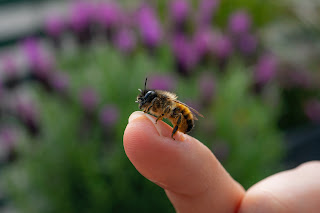
| Curious honey bee on a finger. |
Sunday, October 1, 2023
Don't BEE Scared
Friday, September 1, 2023
Different Ways to Help Honey Bees
Honey bees are vital for the pollination of many of our fruits and vegetables. Making sure we are all doing our part in helping them survive and grow is very important.
Honey bee population numbers in the United States have been decreasing over time until about 10 years ago, but the population numbers have remained fairly stable since then. However, there are several things we can do to help honey bee populations.
- Grow a bee friendly garden:
- Planting garden flowers and native wildflowers are a great source of nectar for honey bees! Some key flowers to plant are bee balm, sunflowers, lavender, goldenrod, and many more! In addition, planting trees, such as maples or black cherries, provide many blooms that support honey bees.
- Avoid pesticides and herbicides
- Using pesticides and herbicides can be harmful to honey bees and other pollinators. Not using pesticides and herbicides can help honey bees, but if they need to be applied make sure to not apply them when flowers are blooming and do it at dusk or dawn when honey bees are not foraging.
- Support beekeepers
- Buying honey and related products can be a great way to support honey bees. Another way to support both beekeepers and honey bees is to contact a beekeeper if you see a honey bee swarm. Beekeepers can help provide a safer home for honey bee swarms, which helps everyone out in the end.
- Be an advocate for honey bees
- Teach others the importance of honey bees and other pollinators and ways they can help. Not everyone understands that honey bees are the number one pollinator in the world and their survival and success is so important!
Tuesday, August 1, 2023
Home Sweet Home and The Beeswax Builders
The houses we live in provide protection from weather and the outdoor elements as well as a safe place for us to sleep. In contrast, honey bees must put on their construction hats and build their own home. Once honey bees find a safe spot to build their home such as inside a tree or in a hive box, they start building their walls out of a special material called beeswax. These walls are not only their home but also a storage space for honey and other important things.
![]() |
| Honey bees storing honey in their hive made of beeswax. |
Worker bees that are 6-7 days old develop
their 8 wax glands within their abdomen. These glands allow them to produce and
secrete beeswax in the form of fragile flakes. Next, the worker bees peel off
these flakes and chew them using their mandibles. This allows them to stick the
beeswax to a surface and mold it into their favorite shape with six sides-- the
hexagon. Each individual hexagon is called a cell. Hexagons are honey bees’ favorite shape
because they use the least amount of beeswax to allow for the most amount of space
inside each cell. The hexagons collectively
serve important purposes within the hive.
![]() |
| Worker bee producing beeswax flakes from her abdomen. |
![]() |
| The shape of a hexagon has 6 sides. |
This clever construction of hexagon cells made of beeswax allows the honey bees to store their precious foods such as nectar, honey, or pollen. Additionally, the queen bee lays a single egg in each of these cells around 2,000 times a day, ensuring the growth of the colony. The walls of a bee hive are super close together. They leave just enough space for one or three bees to fit in between. This special arrangement helps the honey bees control the temperature inside the hive easily. Ultimately, honey bees are very resourceful and are remarkable mathematicians, engineers, and scavengers!
![]() |
| Beeswax walls close together help honey bees regulate the temperature of the hive. |
Saturday, July 1, 2023
How Honey Bee Pollination Works
If it weren’t for honey bees and other pollinators, we would lose out on a lot of food that we eat on a daily basis, such as apples, oranges, and almonds. In fact, ⅓ of the food crops we eat are dependent on pollination and 80% of the pollination is done by honey bees.
Pollination of flowers and crops is accomplished by honey bees through a simple process. Honey bees land on flowers to primarily collect nectar to make into honey, but also collect pollen on the millions of hairs that they have. They then fly to other flowers of the same type and pollen is dropped off when the honey bees collect more nectar. This then pollinates the blooms so that fruits, vegetables, nuts, and seeds are able to grow into the food we eat. More specifically, the pollen from the anther of a flower sticks to honey bees which is then inadvertently carried to the stigma of the flower, which is shown in the picture below.
| Honey bee pollination is done by carrying pollen from the anther of one flower to the stigma of another flower. |
Thursday, June 1, 2023
The Journey of Honey: from Flowers to your Kitchen
Have you ever wondered how that jar of honey ended up in your kitchen? Honey bees are the incredible creatures behind the making of honey, and their process is quite fascinating. Let's take a closer look!
To make honey, honey bees start with an important ingredient: nectar. Flowers produce nectar, and honey bees collect it and bring it back to their hive. Inside the hive, they store the nectar in hexagonal cells made of beeswax.
![]() |
| Honey bee collecting nectar from a flower. |
![]() |
| Nectar in beeswax cells inside a honey bee hive. |
Next comes a special step called "fanning." Honey
bees fan their wings over the nectar-filled cells, creating a gentle breeze.
This breeze helps to dry out the nectar. This drying process is what transforms
the nectar into honey. When the nectar's moisture level drops below 18%, it
officially becomes honey.
Once the honey is ready, the honey bees seal the cells with
beeswax. This ensures that the honey is stored safely for a long time because honey
has a low water content and a high sugar content, making it difficult for
bacteria to grow. That's why honey never spoils as long as it remains sealed,
just like the jar of honey in your kitchen.
![]() |
| Capped honey cells inside a honey bee hive. |
When beekeepers harvest honey, they take frames filled with
capped honey cells. They carefully scrape off the beeswax caps using a bread
knife or an uncapping tool, revealing the honey inside. These frames are then placed in a machine
called a honey extractor. The centrifuge spins the frames rapidly, and the honey is
separated from the cells. It collects at the bottom of the machine and is drained
into a bucket. Once in the bucket, it's ready to be bottled.
![]() |
| Beekeeper using a tool to scrape off beeswax cappings. |
![]() |
| Honey frames in a honey extractor. |
Honey is not only delicious but also precious. It takes the entire lifespan of 12 honey bees to produce just one teaspoon of honey. So when you enjoy honey, make sure to savor every drop and appreciate the hard work of those amazing honey bees.
Monday, May 1, 2023
Top Flowers & Plants Honey Bees Like
Honey bees collect nectar and pollen from the flowers and plants they visit. However, there are certain flowers and plants that they tend to visit more than others. Knowing which flowers and plants that better attract honey bees can allow you to plant the right ones in your garden. Each type of flower has a different blooming season, length of life, and how tall they are. Knowing these details allows to you pick the perfect ones based on your needs.
Some of the top flowers that honey bees like are:
Bee Balm
- Blooms in the Spring, grows back every year, and grows to 1-4 feet tall.
- Bloom in the Summer and Fall starting the 2nd year, grows back every year, and grow to be 1-3 feet tall.
- Bloom in the Summer and Fall, grows back every year, and grows to 2-4 feet tall.
- Bloom in the Summer and Fall, only grow/live for one season, and can range in height from 1-15 feet tall.
- Blooms from late Summer to Fall, grows back every year, and is about 3-4 feet tall.
Saturday, April 1, 2023
The Inside Scoop on Beekeeping Tools
Happy Spring! As beekeepers are opening up their honeybee hives to prepare for another year of pollination and honey making, let's learn about the handy everyday tools that beekeepers use to check on their hives. Beekeepers across the United States utilize different methods of hive maintenance. Some of which have existed for centuries! There are a variety of ways to keep bees, but generally all beekeepers would agree that there are three vital tools required for going into a beehive. Let's explore the inside scoop on the essential tools of a beekeeper!
Hive Tool
![]() |
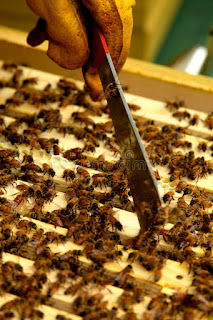
| A hive tool is used to separate frames inside a honeybee hive. |
![]() |
| Hive tools come in different styles. This is one of the most common. |
![]() |
| Beekeepers wearing a full-body bee suit which protects them from potential stings. |
The next essential tool provides protection from stings. Some beekeepers use a cap and vail, which protects the face, along with long-sleeved and pants when working with a colony that they are familiar with. Other beekeepers wear a full body suit with thick layers of mesh that prevent bee stingers from reaching their skin. This is great for inspecting unfamiliar colonies. The downside to this full-body bee suit is that you could be mistaken for a giant marshmallow. However, during the hot summer, the hot weather may have you feeling more like a s'more in these bee suits. To complete the picture, all we need is a campfire, which brings us to the last tool of this inside scoop.
Smoker![]() |
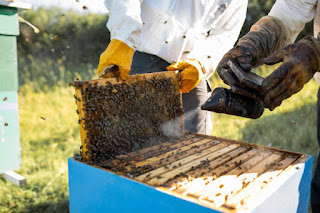
| A smoker puffs smoke on the hive to mask alert pheromones. |
The smoker, or as I like to call it, the travel-sized campfire, is used to puff smoke onto the beehive to mask the alert pheromones (which smells like bananas) honeybees may produce when their hive is opened. This way they are more likely to behave calmly, allowing for an easier hive inspection. The smoker requires a flame and some fuel such as grass clippings, cotton, hay, pine needles, or other kinds of fuel that do the trick without harming the bees. It's very important that beekeepers ensure the smoke remains cool to prevent hurting the honeybee's wings. Once you're finished using the smoker, you'll need to scoop out the remaining fuel. Scooping out the remaining fuel can be challenging without the proper tool. That's where the hive tool also comes in handy, with its long, metal stick perfectly suited to the task. Ultimately, a beekeeper's toolkit would be incomplete without the hive tool, protective attire, and a smok
er.
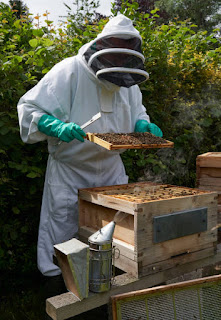
Can you spot all three essential beekeeping tools mentioned earlier in the photo below?
![]() |
| Spot the tools of a beekeeper! |