Saturday, September 1, 2012

From the Hive to the Bottle: Extraction!


One of my favorite things to eat for breakfast in the morning is a peanut butter and honey sandwich, and I love to bake with honey. Have you ever wondered how beekeepers get the honey from the honeybees and put it in a bottle? Beekeepers do that through a process called extraction!  Let’s take a look.
This bee brush is used to get the bees off from each frame!
Step 1: The first thing beekeepers have to do is take the honey supers, or boxes of extra honey, off the hive. To take the boxes off, beekeepers must first remove the bees from inside. There are many different ways they do this. They might use a special scent that the bees don’t like so they leave the box. Another way beekeepers get the bees out is by brushing them off each frame by using a bee brush, and there are even bee blowers that beekeepers can use to blow the bees of from each frame – kind of like a vacuum only it blows air out.

A beekeeper using a hot knife to get the wax cappings off. 
Step 2: Once the honey has been taken off the hive, and the majority of the bees are gone, the next step is to remove the wax cappings that cover the honeycomb on each frame. You see, when honeybees are making honey, they put the honey in beeswax cells and put a thin layer of beeswax over the top to keep the honey from coming out. To get the wax off, beekeepers might use a hot knife and cut them off or use a machine that will take them off.

This is a type of extractor that you crank!
Step 3: Next, each wooden frame is placed into a big cylinder, metal machine or piece of equipment called an extractor. Some beekeepers have big extractors that may hold hundreds of frames at one time, and others may have smaller ones that only hold a few.  

Step 4: Either by cranking or by a machine, the extractor then spins the frames in a circle at a high speed, which causes the honey to fly out of each frame like a centrifuge. The honey slides down the sides of the extractor, and can then be strained to take out anything that got in the honey like beeswax pieces or pollen.
Straining the honey!

Step 5: The honey may be put into a storage tank before the last step, which is to bottle the honey. Like you see in the picture, the honey flows right into each bottle.

Step 6: The honey is taken to be sold at a store or farmers market for you to enjoy!!

So, next time you eat some honey think about all the steps the beekeeper had to take so you could enjoy the liquid gold!

Wednesday, August 1, 2012

Honeybees in your daily routine!

If I were to ask you how you thought honeybees affected your daily activities, what would you say? Maybe you haven't thought of it much before, but honeybees have an effect on most everything you do throughout out the day! Let's find out more by taking a peek into the life of a typical elementary school student.

7:30 AM- Wake up in a bed covered in cotton sheets. Honeybees pollinate our cotton crop every year. In some states, you can find cotton honey on the store shelves!

7:40 AM- Shower and use lotion made with beeswax, a product of the hive that helps seal in moisture.

Cotton is honeybee pollinated!


8:00 AM- Get dressed in a t-shirt and jeans, both of which are made of cotton that is pollinated by honeybees.

8:20 AM- Breakfast: Blueberry pancakes and a glass of orange juice. Honeybees pollinate both blueberry bushes and orange trees. Without honeybees, we would not have these fruits.

8:40 AM- Brush your teeth and use beeswax-coated dental floss.

8:45 AM- Catch the bus to school.

9:00 AM- First class is American History. Many of the crops that were very important to our Founding Fathers were dependent on honeybee pollination. Read more about early American farming here. Do you remember the story about George Washington and the cherry tree?

10:30 AM- Snack time: Apples with peanut butter honey dip. You can tell if an apple has been fully pollinated by slicing it in half to look at the "star" inside. If you count 10 seeds, a honeybee has pollinated your apple completely.

11:00 AM- Art class. Many crayons contain beeswax.

12:00 PM- Lunch: Pizza, fresh fruit, and chocolate milk. Honeybees pollinate a variety of fresh fruits and vegetables, but they also pollinate clover and alfalfa. These crops are used as feed for cattle. Cows eat clover and alfalfa and they are able to produce milk, which an also be made into cheese for your pizza.

12:30 PM- Scrape your knee at recess. The nurse might give you a cotton bandage coated with honey, a natural antibacterial and antibiotic substance!

1:00 PM- Spelling "bee" in English class.

2:00 PM- Learn about insect metamorphosis in Science class. Honeybees are complete insects that go through all stages of development.


3:00 PM- Break the rules and chew a gumball. Many candies are made with a coating of beeswax.

4:00 PM- Get on the bus to go home. Do your homework worksheeet. Paper is a product from trees. Did you know that trees have flowers, too? Some trees are pollinated by honeybees, ensuring that seeds will form and new trees will grow!

5:30 PM- Dinner: Spaghetti with meatballs, Parmesan cheese, garlic toast, and a glass of apple juice. Honeybees pollinate the vegetables in your spaghetti sauce, the feed for cattle that produce the milk needed to make the Parmesan cheese and the butter on the garlic toast, and also the apples needed to make your apple juice.

The average person is affected by honeybees at nearly every stage of the day! Tomorrow, take some time to think about all of the ways that honeybees change your life for the better and remember the hard work they do!

Sunday, July 1, 2012

Home Sweet Hive


Hives can be many different colors, but as you
can see,they are like boxes that beekeepers stack up!
Just like you have a home that you live in, honeybees also have a home they live in too! Beekeepers call this home the hive; you may have seen a beehive in a field or orchard while on a trip with your family! Today, we are going to talk about the different parts of the hive.
This is what it looks like inside each hive box. As you
can see there are 10 wooden frames that we can take out!

Each hive is made up of boxes, which have wood on four sides and are open on the top and bottom. Beekeepers stack up these boxes and paint them.  Often they are painted white, but some hives are brightly colored! In each box, there are 8-10 rectangular frames that fit perfectly inside.

This is a close up picture of a frame. You can see the
yellow foundation that beekeepers put in the middle
so that honeybees could start building beeswax. 
The outside of each frame is made out of wood, and on the inside, beekeepers give the honeybees a thin sheet of beeswax, which we call foundation.  From that beeswax sheet, the honeybees build six-sided beeswax cells. The hexagon is the perfect shape for the bees to make in order to not waste space or beeswax! Inside the beeswax cells the honeybees will store everything they need to survive: the queen will lay eggs in some cells, and in other cells the bees will store honey and pollen.

In the spring, beekeepers usually start out with one box because after winter there aren’t a lot of workers to fill the box up with honey, but as summer goes on the honeybees will run out of space in that one box, so beekeepers put another hive box (with frames) on top of it.

In the boxes on the bottom of the stack, the queen lays eggs. Beekeepers call this section the “brood chamber” because that’s where the eggs, larva, and pupa (called “brood”) of the honeybees develop before they hatch out of their cells.

Since beekeepers don’t want the queen to lay eggs where the bees store the honey in the hive, sometimes we put a queen excluder in the hive. The queen excluder looks like a wire rack that the worker bees can fit through to get to the top of the hive, but the queen’s body is too big to fit through, so she stays at the bottom of the hive. This queen excluder is placed right on top of the brood

The Queen Excluder keeps the Queen in the bottom boxes!
As you can see, it's like a wire rack. 
After the queen excluder is put on the hive, beekeepers keep adding more boxes on top of it as the honeybees make more honey. Beekeepers call these boxes “supers” because that’s where the honey is stored. By the end of summer, the hive could be taller than you!

At the very top of the hive there are two covers. There is an inner cover, which gives the bees a little more room or insulation, and an outer cover or telescoping cover protects the hive from rain and predators.

A very tall hive because the
bees made lots of honey!
Keep an eye out for a honeybee hive next time you’re traveling somewhere!

Friday, June 1, 2012

Swarm Season!

It’s June… and you know what that means. School’s almost out for summer! I’ll bet you’re ready to just buzz on out of the classroom and start enjoying your time outside. And that’s just what the bees are ready to do, too! The period of time between mid-May and mid-June is typically referred to as swarm season, because honeybee colonies all across the country are splitting up and dividing in anticipation of summer’s abundance.

 Perhaps you’ve seen a swarm hanging from a branch or clustered on a fence post. You may have felt a little bit scared or uneasy, but don’t panic! The honeybees in that swarm are extremely gentle. They do not want to give up their life to sting you because they are protecting something very special. Deep inside the core of that living ball of bees is a queen bee. The workers surrounding her are protecting her while they send out scout bees to find a new home.

 But why do bees swarm anyway? During the winter, the queen stops laying eggs and the population of the hive decreases until spring. Once the queen begins to lay up to 3,000 eggs each day in the spring time, the hive becomes very crowded. When it is too full, worker bees start to produce queen cells (visit the January blog post for more information on queen cells). At just about the same time that the new queens are due to emerge from their cells, worker bees start to rush around inside of the hive, telling other workers that the time is right, and urging them outside of the hive. Eventually, the queen bee and up to half of her workers leave the hive and settle in a new home. The hive is no longer crowded, and it now has a brand new young queen bee, ready to start laying eggs.

 Many beekeepers keep busy during swarm season catching swarms. Because a swarm is a cluster of bees with a queen, it is very valuable. Due to the gentle nature of swarms, a beekeeper can easily shake the bees into a new hive and then add it to his bee yard. 


 If you see a swarm of bees in your area, don’t be afraid. Just call your local beekeeper as soon as possible. If you don't know a beekeeper, look online to see if you can find a local or state beekeeping club's contact information.  You can also try calling your county's extension office.  Watch the swarm rescue process from a safe distance- you’re sure to bee amazed at what you see!

Tuesday, May 1, 2012

How Honeybees Fill your Plate


In school, you might have learned about “My Plate”, which is similar to the food pyramid, and tells us the amount of food in each category we are supposed to eat each day like you see in the picture. Today we are going to talk about how honeybees help get that food to our plate.

Did you know that unlike most insects, honeybees are fuzzy? They have little hairs all over their bodies--even on their eyes! When honeybees fly away from their hive, they go to flowers to collect nectar, but while they are collecting nectar, they are also doing something else that is very important: pollination.
You can tell how fuzzy honeybees truly are from this picture!
Pollen from the flower that the honeybee visits sticks to the little hairs all over the honeybee’s body through static electricity. Have you ever rubbed a balloon on your head and then stuck it to a wall? The pollen sticks to the honeybee in almost the same way. A honeybee may fly to over 100 flowers on one trip, so the pollen from the first flower gets moved to the next flower, and the pollen from that flower gets moved to the next one, and so on. When the honeybee pollinates a flower, it allows that flower to make a seed.

This is part of an apple, and you can
tell it was pollinated because of the seeds!
According to MyPlate, HALF of what we are supposed to eat every day is fruits and vegetables! What kinds of fruits and vegetables do you eat that have seeds? Apples? Oranges? Cucumbers? Pumpkins? Watermelon? I bet you can think of many more! Honeybees pollinate many of our fruits and vegetables, and so they already help fill about half of our plate.

A field of buckwheat that is pollinated by honeybees
Next, about a quarter of our plate is
 grains. Although the wind pollinates many of the grain crops, honeybees are still important for some. One type of wheat that honeybees pollinate is buckwheat. Buckwheat is often used to make pancakes! If we didn’t have honeybees we would be missing some grains!

The last quarter of our plate is protein; nuts, beans, and meat make up this section of our plate. Did you know that honeybees pollinate many of these foods too? Over 1 million hives each year go to California to pollinate almonds, one type of nut. Honeybees also help pollinate different beans like lima and kidney beans. Honeybees even make it possible for us to have meat and dairy products because honeybees pollinate alfalfa, which is a food that cows and other animals eat!

As you can see, honeybees pollinate many of the foods that help us fill up our plate. One out of every three bites of food we eat is pollinated by the honeybee!

Let’s eat!

Sunday, April 1, 2012

Honeybees and Easter

What are the first things that come to your mind when you think about the Easter holiday? Bunnies, baby chicks, egg dyeing, and of course many different candies… Do you think about honeybees? Many people don’t realize, but honeybees play a very important role in this special holiday because they produce beeswax.

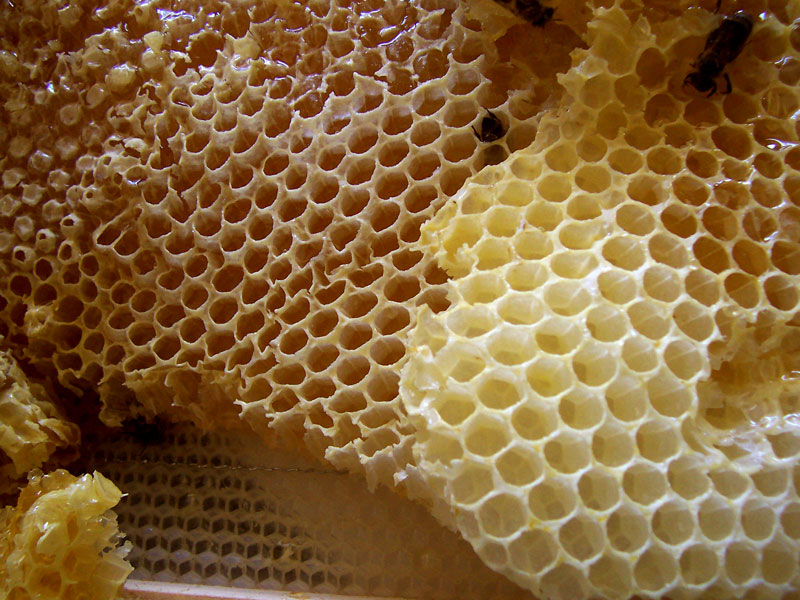
Natural honeycomb inside the hive.
Worker bees secrete beeswax from four paired glands on the underside of their bellies. Beeswax is used to build honeycomb inside of the hive, but beekeepers can harvest beeswax from the hive and use it in many different ways.
Paschal candles are 51% beeswax!

The most common use for beeswax is in candle-making. During the Easter season, the Catholic Church burns Paschal candles, which are special candles made with at least 51% beeswax. Beeswax burns brighter and with less smoke than other waxes, and the candles last for a longer time.

Decorating a pysanky egg.
If you enjoy dyeing Easter eggs, then maybe you would like to try decorating Ukrainian pysanky eggs. These eggs are dyed many times using beeswax which covers the egg in patterns on each layer. The result is a beautiful and elaborate brightly colored Easter egg.

Beeswax is also an important ingredient in many candies. Do you like jelly beans? Beeswax is sometimes added to the shell of jelly beans to keep them firm. Many chocolate candies have a coating that is made from beeswax. This gives the candy its shine and protects it from melting quickly.  But don't worry; you really can't taste it!

This upcoming Easter, as you decorate eggs and enjoy yummy candies, remember to thank the honeybee for her role in making your Easter celebration great!

Thursday, March 1, 2012

More bees, please!


          One common question that we get asked in schools is, “Where do you get your bees from?” With spring being just around the corner, beekeepers are starting to think about how many colonies or hives of bees they want this year. Beekeepers may want to get colonies for several reasons; he or she may be just starting this new hobby for the first time, getting more colonies to replace the ones that died over winter, or adding more hives to their operation.

            There are a few ways beekeepers can get more colonies of bees. They can try to catch a swarm of bees that may have left a different beekeeper’s hive or is living in the wild (this can be very difficult), beekeepers can buy hives from other beekeepers, or they can order packages of bees. Today we are going to talk about packages of bees.  

Beekeepers shaking a frame of bees into the funnel
that leads to the package. 
            In different parts of the United States there are beekeepers that raise package bees. Typically they live in warmer climates like California or Georgia. These beekeepers will take bees away from colonies that are “boiling over” with bees. In other words, the colonies are really healthy, and it would not hurt the colony to take bees away from it. The beekeeper will take frames that are covered with bees from these colonies and shake them into a type of funnel that leads into a package, and the package is on top of a scale. Here is a picture of a package: 


As you can see, it is similar to a wooden box with screened sides. The beekeeper will continue to shake bees into the package until it weighs 2 or 3 pounds. Each pound contains around 3500 bees.

A Queen bee inside of her separate cage. This will be put
inside the bigger package! 
            Once the package is the correct weight, a queen bee is put in the package, but she is kept in a separate cage that looks like this. She is kept in a cage so the other bees in the package get used to her and accept her as their new queen!

            The last thing that is added to the package is a can of sugar syrup. The bees have a long trip before they arrive at their new home, and they will eat the sugar syrup while traveling.

            Lastly, the bees are put on a semi-truck and are delivered to the beekeepers who ordered them. It’s just like when you receive a package in the mail, except the package buzzes a bit more!