Friday, July 1, 2011

A Sweet Difference

     Did you know that there are different types of honey? The type of honey is determined by what plant the honeybees gathered the nectar from. This is because the nectar varies from one plant to another, which gives us many types of honey. In fact there are over 300 types of honey in the United States and about 3,000 worldwide!!!

Liquid, comb, and creamed honey!

      Honey ranges in color from water white to black, and the darker the color the more robust the flavor. Buckwheat honey, which is a very dark honey and has a strong flavor, is used by many people to sweeten their tea or coffee; whereas clover honey, which has a milder flavor, is used by many people for baking. 
      Honey not only ranges in color but it also comes in more than one form. Extracted honey or liquid honey is what you would find in the grocery store. Comb honey, which is honey still inside the beeswax, is great when chewed like gum. Creamed honey has been crystallized in a controlled process, leading to a smooth and creamy honey that is great spread on biscuits and toast.
            Different areas of the United States have different types of honey. To find unique, local honeys in your area, visit www.honeylocator.com

Thursday, June 9, 2011

Honey Bee, Honey Bee, What Do You See? Part 2


Cherry blossom, cherry blossom,
cherry blossom...
Now that we've learned about honey bee vision, let's see how they use their special abilities to pollinate, and how you can help them do that!

Because of her excellent vision, the foraging worker bee knows exactly how to find her way back home - even if she's miles away! Honey bees navigate by the position of the sun, which their vision can detect on even an overcast day with just a tiny patch of blue sky showing.


Yum - thank you, bees!
Honey bees also use their 5 eyes to detect the flowers they visit. As the honey bee gathers pollen and nectar from the flowers, she will fly to only one kind of flower on each trip from the hive. For example, she will fly from a cherry blossom to a cherry blossom and then to another cherry blossom. That's a good thing, too, because if she flew from the cherry blossom to an apple blossom, these flowers would not be pollinated and able to bear fruit! This flower loyalty is one of the reasons why honey bees are such outstanding pollinators.

One plant is nice...


One of the best ways you can help the honey bees in your area this spring is to plant flowers for them.

Here are some things to keep in mind when you're
planning your garden:
- Choose flowers that come in some of the honey bees' favorite colors: white, yellow, blue, and purple.
- Remember that honey bees have a fantastic sense of smell, so consider plants with sweet-smelling flowers or herbs with scented leaves. 
...but many plants are even better!

- Because honey bees will visit only type of flower on each trip from the hive, you can help them out by growing several plants of the same kind in one place.

Have fun watching for these remarkable forager bees this spring!

Tuesday, May 31, 2011

Honey Bee, Honey Bee, What Do You See? Part 1


A forager hard at work
Spring has sprung! Now that America is warming up and flowers all over the country are bursting into bloom, you may begin to notice honey bees outside in the sunny spring weather. These bees are called foragers (worker bees who leave the hive to visit flowers). Let's explore how these forager bees perform their important job.

When a forager bee leaves her hive, she moves off in search of 4 things: nectar (to make honey), pollen (to feed to the baby bees - called brood - as their source of protein), water (to use in air-conditioning the hive), and tree sap or resin (to make into propolis, a sticky, brown substance which disinfects the hive and strengthens the honeycomb). She uses her senses of smell and vision to locate these 4 things. However, a honey bee's senses of smell and vision are different than ours.
 

Honey bees don't have noses; instead, they smell through their antennae. Honey bees have an excellent sense of smell - believe it or not, honey bees have even been trained to detect bombs!


You can see 1 of the 3 tiny simple eyes on this
honey bee's forehead, and the 2 large compound
eyes on the sides of her head

Honey bees also see differently than we do. We only have two eyes, but honey bees have 5 eyes: two compound eyes on the sides of their heads and three simple eyes (called ocelli) on their foreheads. Each compound eye is made up of thousands of lenses called ommatidia (kind of like thousands of tiny eyes all in one), and are the eyes actually used for seeing. The simple eyes are used to detect differences in light and shadow, which is helpful when the bee is navigating between plants. Honey bees are also very sensitive to rapid movements. This is called flicker fusion potential. A honey bee probably wouldn't have much fun at the movie theater because the film would just look like lots of still photographs appearing on the screen one after another. The film would have to be sped up quite a bit to look like it was actually moving! 


Honey bees can see the short-wavelength ultraviolet light
(left), but we can see the long-wavelength red light (right)

Honey bees can't see the color red, but they can detect a color we can't: ultraviolet. On the color spectrum, the color red is made up of very long wavelengths which our eyes can detect, but honey bees can see the shorter ultraviolet wavelengths on the other side. However, honey bees do sometimes visit red flowers, because many flowers, including red ones, have ultraviolet markings (called nectar guides) on them that the bees can see. Here is an interesting video about honey bee vision.

On the left is our view of the flower; the picture
on the right shows us what the honey bees see!
Notice the ultraviolet nectar guides (they appear
red in this picture) on the flower on the right.

In the next part of this series we'll talk about how honeybees use their eyes to be so effective at pollinating our crops!


Sunday, May 1, 2011

Honey, more than just a sweet treat

      Honey, the only food made by insects that we eat, has a wide variety of uses.

     The most common use of honey is cooking. Honey can be used to sweeten drinks such as tea and coffee, and on pancakes, waffles, and biscuits! Honey and peanut butter also make a great sandwich! You can mix honey with butter to make honey butter, a sweet spread for toast and muffins! And don’t forget that honey can be used in place of sugar when cooking. When using honey instead of sugar use half the amount of honey (e.g. instead of one cup of sugar, use half a cup of honey). Check out honey.com for great honey recipes and check out our "Cooking with Honey" page for some of our favorites!
    

You can also speed up your healing time with honey! Honey is antibacterial, which means it kills germs. You can put honey on minor cuts, scrapes, and burns. The honey will prevent infections, help the cut heal faster, and prevent scaring. You can also eat honey if you get a sore throat!

     In addition, honey can be used in cosmetics. Honey is a humectant, which means it attracts and retains moisture. Because of this honey is used in lotion and lip balm. The honey keeps your skin moist so it won’t get dry! Because of this, Honey is used in face cream, shampoo, and soap!

Hand cream made with honey


     Next time you make cookies or cake, try using honey!
     

Thursday, April 14, 2011

A Honey of a Cookbook

Every year in September, the town of Lithopolis, Ohio, celebrates National Honey Month at the Lithopolis Honeyfest. Here is what the people of Lithopolis have to say about their wonderful festival:

"Our mission is to celebrate National Honey Month and Lithopolis Honeyfest Day in Ohio, experience the science and art of apiculture (beekeeping), and create a robust atmosphere of art, music, food, fun and people...We invite you to join us for a full day of live entertainment, finer quality arts, kids crafts in the Busy Beehive, photography contest, Honey Cook-Off and sale, bee beards, honey, honey tasting, honey extraction, beekeepers, hive products, observation hives, educational displays, and delicious honey made food."

I (Princess Allison) am looking forward to attending the Lithopolis Honeyfest myself, and I hope to see you there, too! Don't worry if you aren't able to come, though, because you can still participate in the fun! Here's how:

To commemorate the event, every year a Honeyfest cookbook is made containing all sorts of scrumptious recipes that use honey - and your favorite honey recipe can be included, too! If you want to join me in submitting a honey recipe for the Lithopolis Honeyfest cookbook, just go to the event website: http://www.lithopolishoneyfest.com/, click on "Cookbook" at the top of the page, and remember to order one for yourself!

Have fun cooking with honey!

Wednesday, April 6, 2011

Buds, Bees, and Beekeepers

According to the U.S. Department of Agriculture, insects pollinate 1/3 of the food we eat, and honey bees pollinate 80% of that. So, nearly every third bite you eat comes to you because of the honey bees’ hard work.

But wait a minute…what is pollination, anyway?

Pollination is very simple – it’s just the transfer of pollen from one flower to another flower of the same kind. When this transfer takes place, the flower is able to produce fruit and seeds. This means that strawberries and watermelons and cucumbers oranges are flowers first, and the only reason we can enjoy their fruits is because they were pollinated – probably by a honey bee! Here are a few pictures of the flowers that some of your favorite foods came from:


Coffee blossom
Photo courtesy Big Tree Farms


Nectarine Blossom
Photo courtesy www.jomaloniac.com


Sunflower blossom


Now back to the beekeepers…
Cherry blossom
Photo courtesy www.grit.com
iStockphoto.com/Proxy Minder

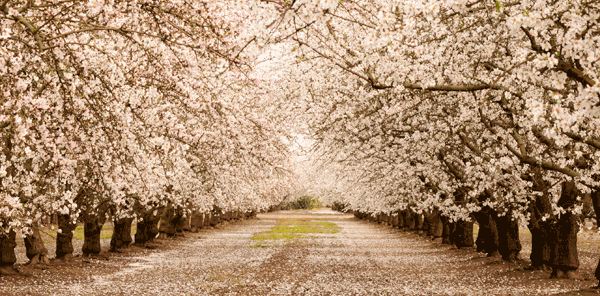
The lemons in your lemonade, the apples in your applesauce, and the cotton in your T-shirt came from plants grown side-by-side in enormous fields like this one:


Almond orchard
Photo courtesy http://www.justalmonds.com/

When these plants bloom, the farmer knows that they are ready to be pollinated so they can produce fruit and seeds. Because there are so many plants blooming at the same time in that field, honey bees must be brought to the field to do the job. But who will bring the bees and how will they get there?

Bees on a truck - can you see the hives
beneath the netting?
Photo courtesy http://www.georgiabees.blogspot.com/
Beekeepers to the rescue!

Beekeepers are people who keep beehives. Some beekeepers have only a few hives that stay in the same place, but other beekeepers have many hives which they move around the country to pollinate plants. When the flowers in the farmers’ fields begin to bloom in the spring, these beekeepers stack their hives onto semi-trucks, strap them down for the ride, and then drive them to the farmer’s field. The farmer pays the beekeepers, renting the number of hives his crop will need to be well-pollinated, and then the beekeepers set their hives in the field or orchard. The bees remain there until they have pollinated the crop (that’s a lot of flowers!), and then the beekeepers load the hives onto the truck again to drive to the next field in need of pollination. Meanwhile, the flowers in the first field can produce fruit and seeds which the farmer can harvest and ship to the restaurants and grocery stores where we can find them!

So this is how the honey bees and the beekeepers who keep them bring us nearly 1/3 of our food!

Watch Pollen Nation by Singeli Agnew and Joshua Fisher (http://www.pollennationthemovie.com/) for a a great video on the importance of honey bee pollination.

“Bee in the Know”: Honey bees pollinate more than 90 different crops in the United States.

Wednesday, March 2, 2011

The Sweet History of Beekeeping

     Beekeeping began about seven thousand years ago. The earliest beekeepers may have removed sections of trees inhabited by honeybees and then carried them back to their village. The first evidence of honeybees being kept in some type of hive dates back to ancient Egypt.

     Lower Egypt (which is actually farther north than Upper Egypt) is where the majority of the beekeeping in Egypt took place. Beekeepers used wicker baskets covered with clay as hives for the honeybees. They were much like the skeps used years later. Because the bees were easy to move, they could be transported from one field to another for pollination. In fact, the ancient Egyptians put hives of bees on boats and would take them down the Nile River, stopping during the day for pollination and then moving farther down the river at night. Honeybees were so important to Lower Egypt that a hieroglyph (a form of ancient Egyptian writing) in the form of a honeybee was chosen as the symbol for the region. One pharaoh was even called The Beekeeper.

     Honeybees were also important in other areas of the world. In fact, honey was the primary sweetener in many places until sugar was introduced. The wax produced by bees, beeswax, has also been used for hundreds of years. The ancient Egyptians used beeswax in shipbuilding and during the Middle Ages beeswax was used to make candles.

     Today, honeybees are still used for pollination. While present day beekeepers may not transport their bees up and down rivers, they do load them on tractor-trailers and transport them across the country for the pollination of many crops such as oranges, blueberries, almonds, and apples. Even though beekeeping has greatly changed since ancient Egypt, honeybees are just as vital now as they were seven thousand years ago