Showing posts with label honey varieties. Show all posts

Sunday, September 6, 2020

National Honey Month

September is National Honey Month! It is a time to celebrate and offer our thanks to honeybees and beekeepers across the United States. Typically, honey collection season ends in September and many are enjoying a freshly extracted crop of honey. Yum!

Honeybees are responsible for pollinating 1/3 of our food, their contribution valued at $20 billion! In her 6-week lifetime, a single worker bee produces approximately 1/12 of a teaspoon of honey by visiting around 2,600 flowers. Amazing! Honey comes in a variety of colors and flavors based on the nectar source. During this pandemic time, we have started a new YouTube video series teaching about different honey varieties from all over the Unites States. We invite you to follow along!


Friday, June 1, 2018

Honey Varieties

The Clover Honey pictured is made from the nectar of
the purple clover flowers also pictured.

Honey is a sweet treat that our honey bee friends make! The honey they make, and we enjoy, is made from the nectar of flowers. Each flower has a unique nectar that produces a unique honey. There are more than 300 different honeys in the United States, and more than 3,000 in the world. 


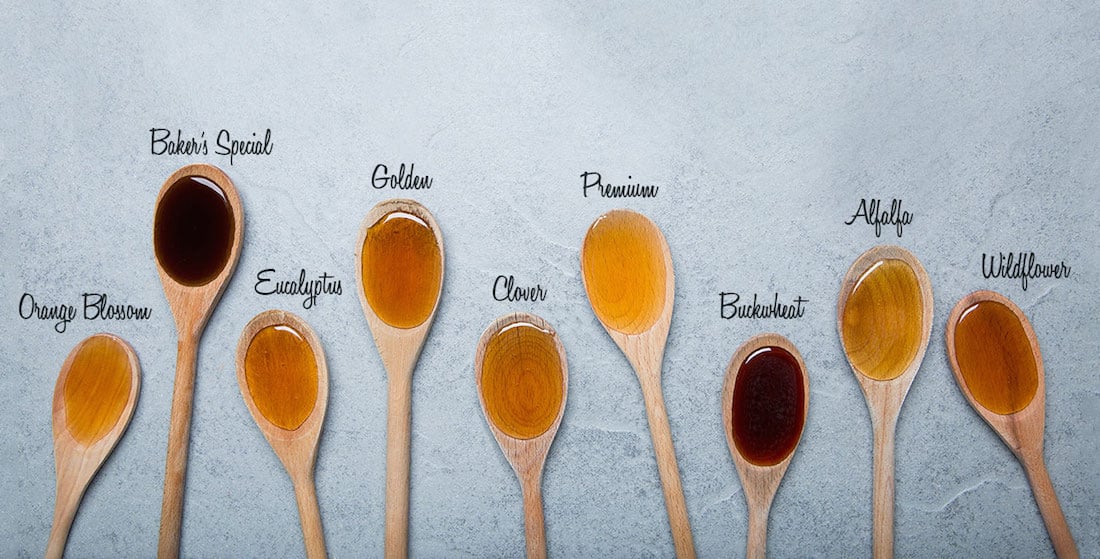
Those hundred and thousands of honey varieties have different tastes, textures, colors, and characteristics. Some honeys crystallize quicker than others, while others have an overall thicker consistency. You can have honey that is almost clear in color like Fireweed, but also honey that is so dark you can’t see through it like Buckwheat. With those different colored honeys comes different flavors and uses.

Honey’s beautiful spectrum of colors provide endless opportunity. Darker colored honeys have a stronger taste and can be great for cooking with meat. The lighter colored honey varieties are sweeter and perfect for using in baked goods.


A small sample of the varieties of honey
made by honey bees.
Some honeys even have very unique flavors based on the flowers the nectar came from. Orange Blossom Honey is a lighter colored honey, almost orange in color! It is sweeter and you can taste the citrus in it. Another unique honey is Sage Honey. It is a lighter colored honey that granulates (gets hard) slower than other types of honey.

The next time you are at a farmer’s market or see a honey booth at a fair or festival, look at the different honey for sale. You might see a wide variety of colors, and if you get the chance, you’ll be able to taste the different flavors and textures.

Monday, January 1, 2018

Honey's Top Ten for 2018

Happy New Year, Honey! A new year equals a new you, and 2018 promises to be the sweetest yet. Start your year off right with these TOP TEN honey tips and tricks!

TEN
You're going to need a lot of energy to make it a great 2018! Try this recipe for Honey Energy Bars. Honey is often called "nature's perfect energy." Whereas refined sugar simply has empty calories, honey contains small amounts of proteins, enzymes, amino acids and minerals.

NINE
Sadly, it's likely you or someone in your family will get sick this winter. Try this recipe for Honey Cough Syrup to soothe your sore throat.

EIGHT
Homemade slime, putty and play dough is all the craze among young people! Try this easy recipe for Honey Play Dough.

SEVEN
There are more than 300 varieties of honey in the US. It all depends on the flower the bee got the nectar from! Make a goal to try at least two new kinds of honey in 2018. Buckwheat honey is great in BBQ sauces and wildflower honey would be delicious in honey butter!

SIX
When Spring arrives, plant a bee-friendly garden in 2018! Plant native flowering plants like Bee Balm, Blackeyed Susan or Goldenrod, and choose flowers that bloom at various times throughout the growing season so the honeybees will have a continuous supply of food.

FIVE
Honeybees add nearly $20 billion to the value of US crop production through pollination! As honeybees gather pollen and nectar for their survival, they pollinate crops like apples, cranberries, melons and broccoli. Try this pollination experiment that uses Cheetos!

FOUR
Read a book about honey, beekeeping or honeybees in 2018! Check your local library or read one of our favorites: Jump into Science: Honeybees, The Honeybee Man or What if There Were No Bees?

THREE
Use honey to help with your seasonal allergies! By eating a few teaspoons of local honey each day, your body can build up an immunity to the pollens in your area.

TWO
Did you know Cleopatra used to take baths with milk and honey for soft and silky skin? You can, too! Try this recipe for Milk & Honey Bath Melts.

ONE
Start every day out right by eating honey for breakfast! Try spooning some into hot tea, drizzling it on your peanut butter toast or sweetening up your oatmeal.

Wednesday, February 1, 2017

Make Your Food a Little Sweeter

There are 300+ varieties of honey in the US!
Add a little sweetness to your life this month! What is your favorite way to add honey to your food? You can use honey in meat marinades, candy recipes, baked goods or simply on your toast in the morning. Honey enhances browning, adds a beautiful golden color, retains moisture and enhances flavor in the things you eat. Did you know there are more than 300 types of honey available in the United States? Each floral source (like clover or orange blossom) has its own unique color and flavor. In general, the lighter the honey, the milder the flavor. Darker honeys like buckwheat have a stronger flavor. 

Honey is a natural sweetener, and it's unique taste and blend of trace enzymes, minerals, vitamins and amino acids make it a beneficial substitute to sugar. You can substitute honey in recipes by reducing the liquids of your recipe in to half of what the recipe calls for, you then reduce the heat by twenty-five degrees. When you substitute the sugar with honey, use half the amount of sugar the recipe calls for. 

Our challenge for you this month is to try a recipe with honey! Ask your mom or dad for help. For Valentine's Day, try these Easy Honey Nut Valentine's Day Cookies (Gluten-Free) or Peanut Butter & Honey Rice Krispie snacks. And for President's Day, try a presidential favorite! President Obama loved this apple pie recipe made with local honey, and President Bush loved eating peanut butter and honey sandwiches for lunch. Check out www.honey.com for more recipes, and comment on our Facebook page with your favorite honey recipe!

Wednesday, June 1, 2016

Honey: In the Kitchen

Have you ever tried honey and peanut butter together on a sandwich? How about honey on your pancakes for breakfast? Honey is a great complement to every meal! It can be eaten by the spoonful or mixed with other ingredients to make some deliciously sweet  dishes. 
First, choosing which kind of honey you would like to use. Honey comes in all colors and flavors! In fact, there are more than 300 different varieties of honey in the United States and over 3,000 worldwide. Each of these honeys has a different color and flavor. The flavor of honey is determined by the nectar the bees gathered. Different flowers produce different flavors as well as different colors of honey. Some honey can be light in color and very clear, almost like water. Bees can also make honey that is thick and dark like molasses. Typically, the lighter the honey in color, the milder in flavor. Darker honey is stronger and bolder in flavor. Lighter honeys, like clover honey are great to eat on toast or to sweeten drinks. Many people like to sweeten coffee or hot tea with honey. Honey and green tea is great for when you have a sore throat. The hot tea helps to sooth while the honey coats and works to heal your throat. The next time you have a sore or itchy throat, try adding 2 tablespoons of honey to one cup of hot tea. Darker honeys like Buckwheat are great for cooking and baking. 

Here are three tips when you are baking with honey.
  1. Reduce the liquid called for in the recipe by ¼ for each cup of honey used. 
  2. Add ½ teaspoon of baking soda for each cup of honey used. 
  3. Reduce the oven temperature by 25 degrees F to prevent over browning. 

Whether you’re making a honey glaze for a ham or just adding it to fruits or vegetables in a recipe, the stronger honey will add a bold delicious flavor. Try this simple recipe for honey carrots! Combine 1 cup carrots, 1 tablespoon butter and three tablespoons honey. Heat on medium heat for 12 minutes. Stir and enjoy! Both lighter and darker honey is a great alternative to other syrups. If you want to try something new, use honey instead of maple syrup on pancakes and waffles. Or next time you want some chocolate or strawberry milk, try adding honey instead! Try it on your ice cream. 
Besides its deliciously sweet taste, honey also has many health benefits that make it good for you. Honey is a good source of carbohydrates. Carbohydrates are your body’s primary fuel for energy. This makes it a great energy booster! If you play sports, try some honey before your next game or practice to give you an extra energy boost. Many athletes and Olympians use honey for energy. There are also lots of vitamins and minerals in honey. Vitamins and minerals boost your immune system, help you grow and develop properly and help cells and organs do their jobs. Lastly, honey is antibacterial, so it kills bacteria and keeps you healthy. 
One last tip: remember to keep honey in your pantry--not your refrigerator. The cold will cause it to crystallize. However, if your honey does crystallize, put the container in a bowl of warm water and the crystals will dissolve. Honey never spoils!

Saturday, August 1, 2015

Honey, the Liquid Gold

The many colors of honey!
Have you ever wondered why there are different colors and flavors of honey? Each kind of flower produces a different flavor and color nectar that bees use to make honey. We have different kinds of honey because honeybees are flower consistent. This means that instead of going from one kind of flower to another, (like from a sunflower to an orange blossom, and then to a clover flower) she will work one kind of flower on each trip until there is no more nectar in those flowers. When beekeepers bring their bees to pollinate a specific crop, like blueberries, the bees will only be visiting blueberry flowers, so it will make blueberry honey. There are actually more than 300 different kinds of honey in America, and more than 3,000 kinds in the world! Each type of honey has a unique flavor and color. The color of honey can range from a clear “water-white” to a dark brown color. The lighter honeys have a mild flavor, while darker honeys have a strong, bold flavor. It’s fun to try different kinds of honey and taste and see the difference between each of them.


Besides its deliciously sweet taste, honey also has many health benefits that make it good for you. Honey is a good source of carbohydrates. Carbohydrates are your body’s primary fuel for energy. This makes it a great energy booster! If you play sports, try some honey before your next game or practice to give you an extra energy boost. Many athletes and Olympians use honey for energy. Honey is also full of antioxidants which help protect cells in your body from harmful molecules. There are also lots of vitamins and minerals in honey. Vitamins and minerals boost your immune system, help you grow and develop properly, and help cells and organs do their jobs. Lastly, honey is antibacterial, so it kills bacteria and keeps you healthy. 


Honey is also wonderful to use in cooking, and is useful as more than just a sweetener. It can add a special touch to any recipe. With all the unique flavors to choose from, it can add great flavor to your recipes. Honey is a humectant, which is something that holds moisture and water, so it helps keeps baked goods moist and soft. Honey is antibacterial and antifungal so it keeps bacteria and mold from growing and helps baked good last longer. Honey is also an emulsifier and thickener. If you were to take water and oil and mix them together and shake it vigorously, little oil droplets are dispersed throughout the water. Then, if you let it sit, the water and oil will separate. What an emulsifier does is bind things together, so it would help that water and oil to mix together and not separate. Because honey is an emulsifier and thickener, it works well in sauces and dressings. 

Try this delicious and easy honey recipe to cool off and get energized this summer!

Fruity yogurt honey pops 
Honey is a sweet addition to any recipe.

  • 1 cup - pitted cherries or ½ cup strawberries (or other fruit of your choice)
  • 1 cup - nonfat Greek yogurt
  • 2 tablespoons - honey
In a small food processor or blender, puree the fruit for 30 seconds to 1 minute. Do not blend for too long or the puree will become too watery. In a measuring cup or bowl with pouring spout, stir together the yogurt and honey. Stir in about 2 tablespoons of the fruit puree. Taste and add more honey or fruit puree as desired. Pour fruit and yogurt mixture into popsicle molds, filling about ¾ of the way. Add wooden sticks and freeze for at least 3 hours. To remove: run warm water over the bottle of the popsicle mold and gently twist and pull out the popsicles.