Showing posts with label cooking. Show all posts

Monday, February 1, 2021

Sweet Kitchen Tricks


Using natures sweetener has endless possibilities! From cooking to baking, maybe using it as a sweetener, or utilizing it in your meal as a flavorful glaze, your imagination awaits. Use these 8 sweet kitchen tricks to use honey like a pro.


    1. Get that last drop: Over the course of a worker bee's life, she will collect enough nectar to make 1/12 teaspoon honey. So make sure you get all of the honey out of your measuring cup so you can enjoy her hard work! Before measuring out your honey, spray the utensil down with cooking spray to help the honey glide out of the utensil.                                                                                                        
    2. Crystallized to liquified: Honey will naturally crystallize but you can liquify it by placing the jar in a warm water bath and stiring until the crystals dissolve. You may also microwave a microwave-safe container with the lid off, stirring every 30 seconds until the crystals dissolve. To slow the process of crystallization, store honey at room temperature.                                                                          
    3. Substitute: Honey can be substituted for granulated sugar by beginning to substitute honey for up to half of the sugar that is needed in that recipe. With some experimentation, some recipes can have all of the sugar subsituted with honey.                                                              
    4. Turn the temperature down: Honey can increase the speed of browning in the oven. For baked goods, reduce the oven temperature by 25 degrees to prevent over-browning from occuring.                                                                                                                                          
    5. Reduce the liquid: Honey naturally has more moisture than granulated sugar so to acheive the same consistency that you would with granulated sugar, you need to reduce the liquid used. For every cup of honey that is used in the recipe, reduce any liquid by 1/4 cup.                      
    6. Neutralize: Honey has an acidic nature making it great for marinades as the acid can tenderize meat. To neutralize the acid when baking, add 1/4 teaspoon of baking soda for each cup of honey that is used. The acidic nature of honey is what makes honey self-preserving.                                                                                                                      
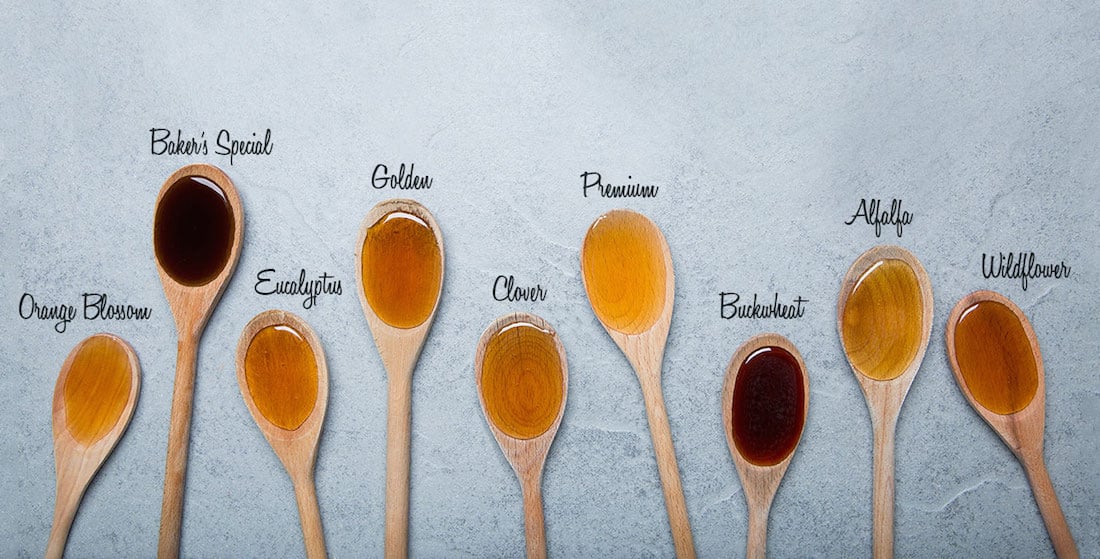
    7. Choosing honey: There are over 300 varieties of honey available in the United States, each with a different flavor because of the floral source. So how do you choose which type of honey to use for each recipe? A lighter colored honey typically has a milder taste while a darker honey will have a more bold flavor. A dark honey is great to use in sauces and a lighter colored honey tastes splendid in tea or lemonade. Experiment with the many different varieties of honey to see which honey works best in your favorite recipes.                                                                                       
    8. Honey conversions: If a recipe calls for 1 cup of honey, all you will need is a 12 ounce jar of honey. The conversion is 1 cup = 12 ounce jar of honey. 

Experiment with the over 300 varieties of
honey available in the United States!

Thursday, October 1, 2020

Make Your Favorite Recipes with Honey!

Cooking with honey is fun! You can use your favorite type of honey and end up with a completely different taste in the end. If you make these simple changes to your favorite recipe, it will come out with the same texture you love, and even tastier!
  1. Reduce your oven temperature by 25°F if baking – You don’t want your dish to burn or get overly brown!
  2. Use honey for half the measurement of sugar – Honey naturally tastes sweeter than sugar, so you don’t need to use as much to get the right sweetness.
  3. Reduce liquids by ¼ cup for each cup of honey used – Honey is a liquid while sugar is a solid. Taking out some of the liquid makes your dish come out with the right consistency.
  4. Add ½ tsp baking soda for each cup of honey – This is important because honey is slightly more acidic than sugar. The baking soda balances the pH difference.
There are so many different colors of honey!
Did you know that there are over 300 different varietals of honey in the United States and over 3,000 in the whole world? We get the different colors and flavors depending on where the honeybees gathered the nectar from. Some nectars are lighter and some are darker, but they all taste delicious!  

Try experimenting with the different varietals of honey in your recipe. I like to use dark honey such as buckwheat when cooking meats and light honey when making smoothies.

Did you know that honey is a preservative? That means if you make your recipe with honey it won’t go bad as quickly! I especially love to make cookies or bread with honey because it will stay moist and fresh longer.

If you want to walk through a recipe with me while I make the conversions, you can watch it on our YouTube channel here! I made a Honey Banana Bread, and recommend you try converting your favorite recipe to use honey!


Wednesday, January 1, 2020

Cooking with Honey

Did you know? There are more than 300 unique flavors of honey in the United States! Each of them has a different color and flavor. This is dependent on the nectar sources the bees visit while foraging. If we have a honeybee visiting mainly an orange blossom grove, then that is what we would define as orange blossom honey. There needs to be at least 45% of the nectar and pollen from the dominant source for it to have a prominent flavor. Knowing this, we can play with different types of honey in some recipes to see how it can change the flavor. 

Darker honey tends to be more robust and strong. Lighter honey tends to be more light and mild. Lighter honey like orange blossom, black locust or an early spring wildflower is great in things like smoothies and spreads. Darker honey like buckwheat, chestnut or late fall honey are great for salad dressings, meats and baking because it will have a strong honey flavor.

When cooking with honey, it is likely that things can get messy pretty quick, so here are some tips! A good trick to use is spraying your measuring cup or spoon with non stick cooking spray and the honey will slide right out. Honey will natural crystallize, but it’s still good to eat! Just place the jar or bottle in some warm water. Honey should be stored at room temperature. Honey comes in different forms. Try cream honey, chunk honey and comb honey. See how you can add variety in you meals with these forms.

One of my favorite ways to start my mornings is with a homemade honey berry smoothie. Not only is it a sweet start, it is also a great source of natural energy! My recipe is below, but you can change it up to add your favorite fruits and vegetables.

Princess Nicole’s Honey Berry Smoothie

Ingredients:
½ cup milk
2 tablespoons Honey
1 frozen banana
½ cup frozen blueberries
½ cup frozen strawberries 
½ cup frozen raspberries
2 tablespoons of almond butter(optional)

Directions

Combine all ingredients into a blender. Blend until smooth. Pour into a glass. Enjoy!

Wednesday, February 1, 2017

Make Your Food a Little Sweeter

There are 300+ varieties of honey in the US!
Add a little sweetness to your life this month! What is your favorite way to add honey to your food? You can use honey in meat marinades, candy recipes, baked goods or simply on your toast in the morning. Honey enhances browning, adds a beautiful golden color, retains moisture and enhances flavor in the things you eat. Did you know there are more than 300 types of honey available in the United States? Each floral source (like clover or orange blossom) has its own unique color and flavor. In general, the lighter the honey, the milder the flavor. Darker honeys like buckwheat have a stronger flavor. 

Honey is a natural sweetener, and it's unique taste and blend of trace enzymes, minerals, vitamins and amino acids make it a beneficial substitute to sugar. You can substitute honey in recipes by reducing the liquids of your recipe in to half of what the recipe calls for, you then reduce the heat by twenty-five degrees. When you substitute the sugar with honey, use half the amount of sugar the recipe calls for. 

Our challenge for you this month is to try a recipe with honey! Ask your mom or dad for help. For Valentine's Day, try these Easy Honey Nut Valentine's Day Cookies (Gluten-Free) or Peanut Butter & Honey Rice Krispie snacks. And for President's Day, try a presidential favorite! President Obama loved this apple pie recipe made with local honey, and President Bush loved eating peanut butter and honey sandwiches for lunch. Check out www.honey.com for more recipes, and comment on our Facebook page with your favorite honey recipe!

Wednesday, June 1, 2016

Honey: In the Kitchen

Have you ever tried honey and peanut butter together on a sandwich? How about honey on your pancakes for breakfast? Honey is a great complement to every meal! It can be eaten by the spoonful or mixed with other ingredients to make some deliciously sweet  dishes. 
First, choosing which kind of honey you would like to use. Honey comes in all colors and flavors! In fact, there are more than 300 different varieties of honey in the United States and over 3,000 worldwide. Each of these honeys has a different color and flavor. The flavor of honey is determined by the nectar the bees gathered. Different flowers produce different flavors as well as different colors of honey. Some honey can be light in color and very clear, almost like water. Bees can also make honey that is thick and dark like molasses. Typically, the lighter the honey in color, the milder in flavor. Darker honey is stronger and bolder in flavor. Lighter honeys, like clover honey are great to eat on toast or to sweeten drinks. Many people like to sweeten coffee or hot tea with honey. Honey and green tea is great for when you have a sore throat. The hot tea helps to sooth while the honey coats and works to heal your throat. The next time you have a sore or itchy throat, try adding 2 tablespoons of honey to one cup of hot tea. Darker honeys like Buckwheat are great for cooking and baking. 

Here are three tips when you are baking with honey.
  1. Reduce the liquid called for in the recipe by ¼ for each cup of honey used. 
  2. Add ½ teaspoon of baking soda for each cup of honey used. 
  3. Reduce the oven temperature by 25 degrees F to prevent over browning. 

Whether you’re making a honey glaze for a ham or just adding it to fruits or vegetables in a recipe, the stronger honey will add a bold delicious flavor. Try this simple recipe for honey carrots! Combine 1 cup carrots, 1 tablespoon butter and three tablespoons honey. Heat on medium heat for 12 minutes. Stir and enjoy! Both lighter and darker honey is a great alternative to other syrups. If you want to try something new, use honey instead of maple syrup on pancakes and waffles. Or next time you want some chocolate or strawberry milk, try adding honey instead! Try it on your ice cream. 
Besides its deliciously sweet taste, honey also has many health benefits that make it good for you. Honey is a good source of carbohydrates. Carbohydrates are your body’s primary fuel for energy. This makes it a great energy booster! If you play sports, try some honey before your next game or practice to give you an extra energy boost. Many athletes and Olympians use honey for energy. There are also lots of vitamins and minerals in honey. Vitamins and minerals boost your immune system, help you grow and develop properly and help cells and organs do their jobs. Lastly, honey is antibacterial, so it kills bacteria and keeps you healthy. 
One last tip: remember to keep honey in your pantry--not your refrigerator. The cold will cause it to crystallize. However, if your honey does crystallize, put the container in a bowl of warm water and the crystals will dissolve. Honey never spoils!

Saturday, August 1, 2015

Honey, the Liquid Gold

The many colors of honey!
Have you ever wondered why there are different colors and flavors of honey? Each kind of flower produces a different flavor and color nectar that bees use to make honey. We have different kinds of honey because honeybees are flower consistent. This means that instead of going from one kind of flower to another, (like from a sunflower to an orange blossom, and then to a clover flower) she will work one kind of flower on each trip until there is no more nectar in those flowers. When beekeepers bring their bees to pollinate a specific crop, like blueberries, the bees will only be visiting blueberry flowers, so it will make blueberry honey. There are actually more than 300 different kinds of honey in America, and more than 3,000 kinds in the world! Each type of honey has a unique flavor and color. The color of honey can range from a clear “water-white” to a dark brown color. The lighter honeys have a mild flavor, while darker honeys have a strong, bold flavor. It’s fun to try different kinds of honey and taste and see the difference between each of them.


Besides its deliciously sweet taste, honey also has many health benefits that make it good for you. Honey is a good source of carbohydrates. Carbohydrates are your body’s primary fuel for energy. This makes it a great energy booster! If you play sports, try some honey before your next game or practice to give you an extra energy boost. Many athletes and Olympians use honey for energy. Honey is also full of antioxidants which help protect cells in your body from harmful molecules. There are also lots of vitamins and minerals in honey. Vitamins and minerals boost your immune system, help you grow and develop properly, and help cells and organs do their jobs. Lastly, honey is antibacterial, so it kills bacteria and keeps you healthy. 


Honey is also wonderful to use in cooking, and is useful as more than just a sweetener. It can add a special touch to any recipe. With all the unique flavors to choose from, it can add great flavor to your recipes. Honey is a humectant, which is something that holds moisture and water, so it helps keeps baked goods moist and soft. Honey is antibacterial and antifungal so it keeps bacteria and mold from growing and helps baked good last longer. Honey is also an emulsifier and thickener. If you were to take water and oil and mix them together and shake it vigorously, little oil droplets are dispersed throughout the water. Then, if you let it sit, the water and oil will separate. What an emulsifier does is bind things together, so it would help that water and oil to mix together and not separate. Because honey is an emulsifier and thickener, it works well in sauces and dressings. 

Try this delicious and easy honey recipe to cool off and get energized this summer!

Fruity yogurt honey pops 
Honey is a sweet addition to any recipe.

  • 1 cup - pitted cherries or ½ cup strawberries (or other fruit of your choice)
  • 1 cup - nonfat Greek yogurt
  • 2 tablespoons - honey
In a small food processor or blender, puree the fruit for 30 seconds to 1 minute. Do not blend for too long or the puree will become too watery. In a measuring cup or bowl with pouring spout, stir together the yogurt and honey. Stir in about 2 tablespoons of the fruit puree. Taste and add more honey or fruit puree as desired. Pour fruit and yogurt mixture into popsicle molds, filling about ¾ of the way. Add wooden sticks and freeze for at least 3 hours. To remove: run warm water over the bottle of the popsicle mold and gently twist and pull out the popsicles.